


Rising Costs and Industry Turmoil
The PlayStation 5 launched in 2020 at an accessible price of $399. Now, even six years later, it commands a price tag of $599. At the same time, Nintendo has announced price hikes for the Switch 2, and Xbox has raised its prices three times since 2025. However, these extra costs are only symptoms of a much larger, more alarming issue. Behind the scenes, the entire gaming ecosystem is undergoing a severe shock. PlayStation has announced plans to completely phase out physical game discs, Xbox has shuttered five major production studios and laid off thousands of workers in one of the largest corporate purges in gaming history, and Nvidia has begun imposing hourly limits on its cloud gaming services. These are not isolated incidents; they form a single, destructive chain reaction sweeping through the industry.
The AI Boom and the Global Memory Crisis
To understand why hardware is becoming unaffordable, one only needs to look inside a standard console. A PlayStation 5 contains 16 GB of memory, which is essential for running modern games. In contrast, a single high-end AI chip from Nvidia, such as the Blackwell Ultra, requires 288 GB of memory—the equivalent of 18 PlayStation 5 consoles combined.
While AI memory is specialized, it is manufactured on the same production lines by the same small group of companies. Every gigabyte allocated to an AI server is a gigabyte denied to a consumer console or PC. AI companies do not purchase these chips individually; they buy them in massive racks containing 72 chips each—meaning a single rack equals 1,300 PlayStation 5s. These racks are purchased in colossal clusters. Last year, Microsoft launched a cluster of 64 racks to power OpenAI’s models, consuming the equivalent of 83,000 PlayStations in one go.
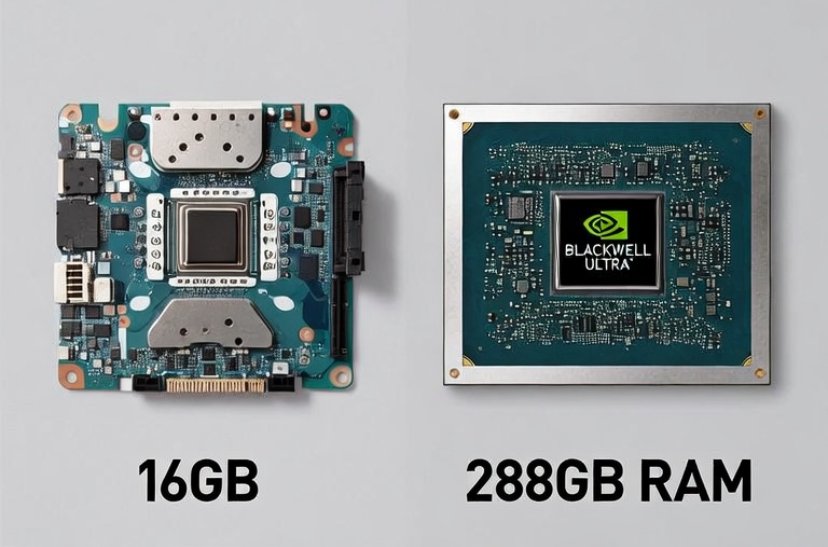
Worse still, OpenAI’s upcoming Stargate campus is reportedly designed to hold 100 times that amount—equaling 8.3 million PlayStation 5s worth of memory in a single location for a single company. When factoring in similar mega-projects from Meta, XAI, Amazon, and Google, AI data centers are estimated to be consuming nearly 70% of the world’s total memory output. This leaves everyday electronics—phones, PCs, cars, and consoles—fighting over a rapidly shrinking remainder.
Supply Constraints and Exploding Component Prices
The global supply of memory is heavily concentrated among just a handful of firms, with the primary RAM market controlled by only three companies: Samsung, SK Hynix, and Micron. While building new manufacturing plants could alleviate the shortage, construction takes three to four years and carries immense financial risk if the AI bubble bursts. Choosing safety over risk, these manufacturers are instead reveling in profit margins of 70% to 80% because tech giants are willing to pay any price to win the AI race.
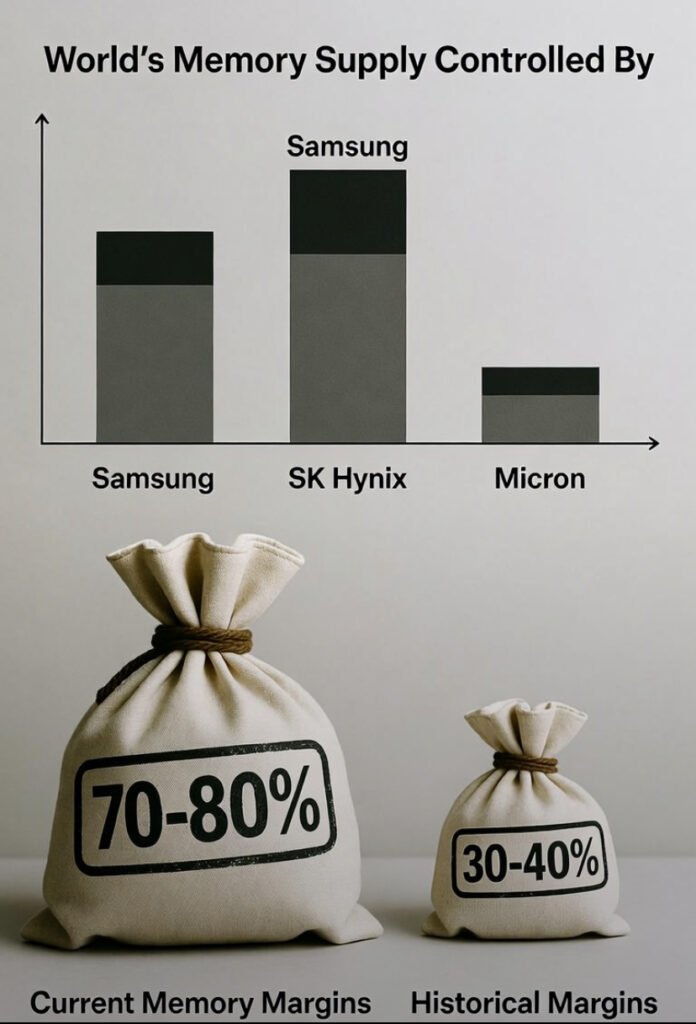
Consequently, component costs have skyrocketed. Within a three-month span, a single 16 GB stick of RAM saw its price jump by nearly 300%. On high-end graphics cards, the basic VRAM surrounding the processor now accounts for up to 80% of total production costs, meaning the raw memory often costs more than the actual processor chip itself.
The Impact on Hardware Sales and Consoles
These exorbitant hardware costs have severely suppressed consumer demand. Following recent price hikes, American consumers purchased fewer PlayStations than in any May since the year 2000, while Xbox recorded the worst May in its history. Industry insiders working on Windows handheld gaming devices have gone so far as to call their own market dead under the weight of rising component costs. Even Valve’s newly released Steam Machine—a box offering performance comparable to a six-year-old console—carries a prohibitive price tag of over $1,000. The home console, long relied upon as an affordable and accessible form of entertainment, is steadily turning into a luxury item.
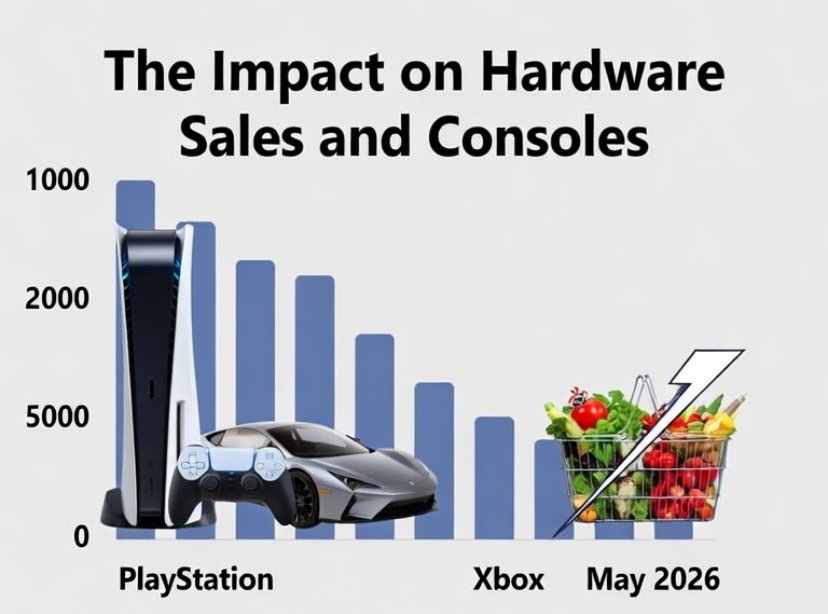
This dynamic threatens the fundamental momentum required for console generations to survive. If the rumored $1,000 price point for the upcoming PlayStation 6 becomes a reality, initial adoption will plummet. Console gaming relies heavily on immediate, massive hardware sales to convince developers to invest years of work into a new platform. If only a fraction of players upgrade while the vast majority remain on older generation hardware, developers will naturally prioritize the legacy install base, cutting off the financial lifeblood of the new generation.
Four Strategies Companies Are Using to Protect Profits
To offset these mounting losses, hardware and software companies are increasingly relying on four aggressive tactics:
- Subscription Inflation: Raising the cost of monthly services like Xbox Game Pass and online subscriptions to make recurring revenue a mandatory part of the gaming experience.
- Game Price Hikes: Pushing standard game prices past the traditional $60 and $70 thresholds toward $80, with industry trajectories pointing directly toward $100 video games.
- Phasing Out Physical Media: Eliminating physical game discs—as Sony plans to do by 2028—to completely dismantle the secondhand market, prevent game sharing, and force all purchases through proprietary digital storefronts at controlled, inflated prices.
- Massive Cost-Cutting and Layoffs: Shuttering studios, firing thousands of skilled developers, and greenlighting fewer original, high-budget titles. Instead, publishers are leaning heavily into safe remakes, sequels, and aggressive in-game monetization, including real-time advertising billboards built directly into game worlds.

The Future Outlook for Gamers
If current trends persist, the traditional console business model faces an unviable future, pointing toward three inevitable shifts:
- Cloud Gaming Dominance: Services like Nvidia’s GeForce Now may become the default option, forcing players to rent hardware via monthly subscriptions rather than owning it locally, complete with usage caps and restrictions.
- A Retreat to Retro Gaming: Players may increasingly settle for older, more affordable classic titles simply because modern hardware and new releases have priced them out of the market.
- A Pivot to Mobile Gaming: As dedicated gaming hardware becomes a luxury, developers may have little choice but to pivot toward smartphones. However, because mobile ecosystems rely on freemium models, microtransactions, and aggressive monetization rather than deep, prestige experiences, the overall quality and scope of future games may fundamentally change.